On 9 June 1991, John Cleland crossed the finish line believing he had won. Frank Sytner thought he’d won too. For a brief period, it seemed entirely possible that neither of them had.
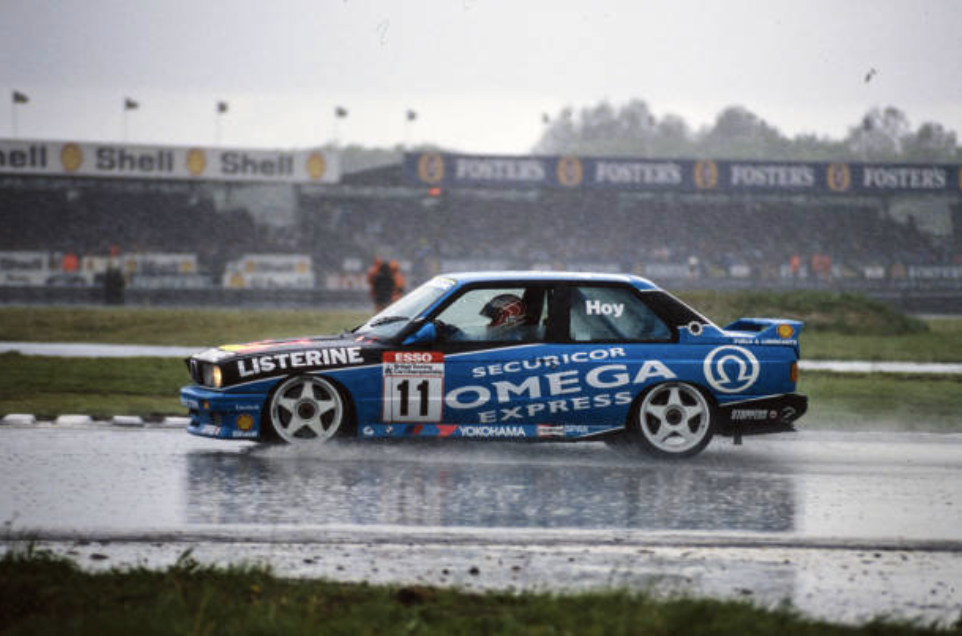
The fifth round of the 1991 British Touring Car Championship had been controversial before the race even started. Tim Sugden produced an impressive qualifying performance to put his Prodrive BMW M3 on pole, only for the car to be found four kilograms underweight afterwards. Officials deemed the discrepancy acceptable because the championship scales were only claimed to be accurate to within 0.5 per cent, a decision which caused dissatisfaction among rival teams, who pointed out that Peggen Andersson had been disqualified at Donington earlier in the season for being just two kilograms underweight. Sugden nevertheless kept pole ahead of Will Hoy, while John Cleland endured a difficult session and qualified sixth with a down-on-power engine and what was described as a “spongy brake pedal”.
Shortly before the race, a sharp shower created another headache. Some teams claimed they had been told the race was declared wet, only to then be instructed to clear the grid. Most stayed on slicks, although Jonathan Palmer, Andy Middlehurst, Gary Ayles and Frank Sytner were among those choosing wets. Hoy made the best start and led Jeff Allam into Copse, while Sugden’s race quickly unravelled after his excellent qualifying performance. Cleland was soon moving forward and passed Allam at Copse on lap two before catching Hoy. A lap later the leading trio were together and, on lap four, Cleland attacked Hoy at Becketts. “I tried to go inside him, he closed the door and I got on the kerb and couldn’t slow down enough,” Cleland recalled. Hoy’s BMW received two blows from the Vauxhall, but both continued and Cleland emerged in front.
The two Vauxhalls of Cleland and Allam soon appeared to have the race under control, but the constantly changing conditions meant nobody could be certain. As the circuit dried, the advantage swung towards those on slicks and Andy Rouse’s Toyota began flying, eventually setting the fastest lap of the race. Sytner’s early advantage on wets disappeared and he fell behind Tim Harvey, only for the weather to change yet again. By lap nine the rain was becoming heavy and suddenly the wet-shod cars were the quickest on the circuit. Palmer and Keith Odor were among those who pitted at the end of lap ten for rain tyres, while the leaders attempted to survive increasingly treacherous conditions.
On lap 11, a large puddle had formed before Brooklands. Forrest and Whale had already spun there, but when the leaders arrived Cleland went straight on and struck the tyre wall. Allam narrowly avoided his team-mate, while Bellm aquaplaned towards the stricken Cavalier. “I just managed to find some grip to accelerate out of the way, but it was close,” Allam recalled. Years later, Cleland admitted that his thoughts had immediately turned to the result. “I was on the radio before I was out of the car saying it was too dangerous. I realised I had to get the race stopped, so I’d still win the race on countback!” Hoy also went off and headed for the pits, while Sytner, still circulating on wets, suddenly found himself perfectly placed. Most observers believed he had completed 12 laps and was leading when the red flags appeared.
What followed turned an already extraordinary race into a farce. The cars initially lined up on the grid before being waved into the pits, where work immediately began. Wet tyres were fitted and damaged cars patched up while officials tried to decide what should happen next. There was considerable confusion about what work could be done to the cars, while no effective effort was made to establish parc fermé. With considerably less than half of the scheduled 25 laps completed, the organisers decided against a restart and instead declared a result after ten laps. That handed victory to Cleland — despite his Cavalier having ended up in the Brooklands tyre wall. Pyramid Motorsport protested, maintaining that the result should have been declared after 11 laps, but the protest was rejected.
Cleland was therefore classified first ahead of team-mate Allam, with Hoy third, Rouse fourth, Bellm fifth and a deeply unfortunate Sytner sixth. It was hardly a victory Cleland could celebrate with much enthusiasm. “I don’t like winning like this, but that’s life,” he admitted afterwards.
There was one final complication. Because insufficient distance had been completed, no championship points were awarded. Cleland had won a BTCC race without gaining a single point, while Sytner had been leading when the red flag appeared yet was officially classified sixth.
Silverstone had somehow produced a pole-position controversy, confusion over whether the race had been declared wet, wildly different tyre strategies, a flooded circuit, a crash for the eventual winner, a red flag, an ineffective parc fermé and a protest over which lap should actually determine the result. After all of that, the record books said John Cleland had won, but the championship standings hadn’t changed.