
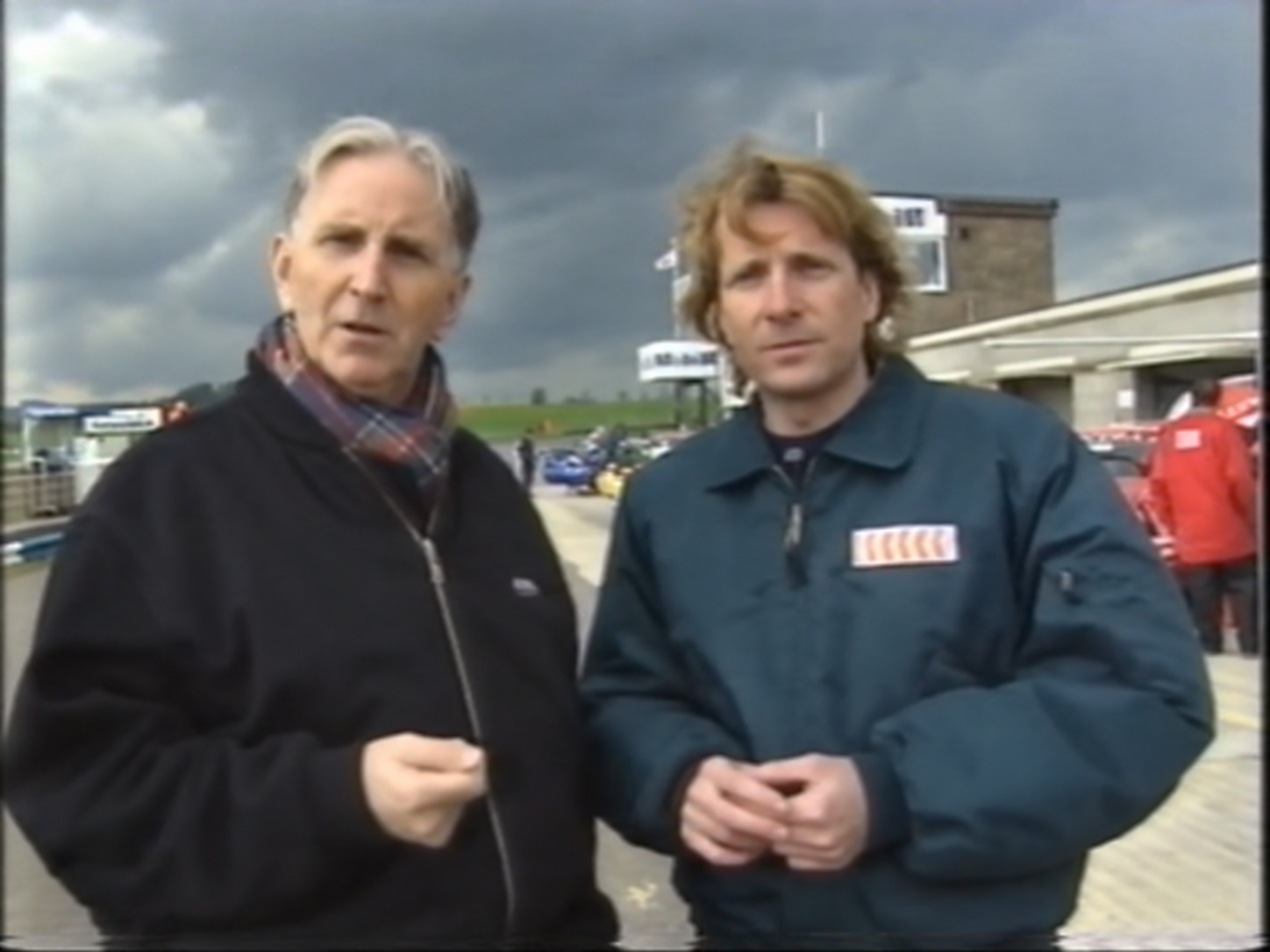
Charlie Cox and John Watson became one of the defining commentary partnerships of the BTCC’s final Super Touring years. Their personalities were very different, but both men still speak warmly about the years they spent together behind the microphone.
Watson had already worked alongside broadcasters including Ben Edwards, Allard Kalff and Andrew Marriott before joining the BTCC coverage, but Cox brought a rather different dynamic. “Charlie is a pretty impressive guy,” Watson recalled. “Working with Charlie was certainly a different experience to, let’s say, Ben or Allard or Andrew Marriott. But I think it gave an audience sort of, ‘Wow, what are they going to come up with next? What’s John going to say next? What’s Charlie going to say next?’” Watson was also quick to praise Cox’s natural broadcasting ability, describing him as having “a very, very good turn of speech.”
The feeling was very much mutual. Cox remembers enjoying Watson’s willingness to make a judgement rather than simply describe what everybody at home could already see. “I loved commentating with Wattie because he would say what he thought. He’d speak up,” Cox recalled. “He’d have an opinion. He’d make it really clear.” Cox felt Watson’s experience as a Grand Prix winner gave him genuine authority in the expert role. “His judgements were good and he would make the judgements. That’s the key,” he explained. One of his favourite examples was Watson’s famous “Rude Boy Tim” verdict on Tim Harvey.

Their contrasting personalities became a large part of the appeal. Cox was there primarily to lead the commentary and react to the spectacle, while Watson analysed incidents and was rarely afraid to criticise what he had just seen. Cox summed up the difference between them rather neatly: “He’s naturally disapproving and I’m naturally fun.” Watson, meanwhile, said he felt “very fortunate, very privileged to have the opportunity for the three or so years that I did it with Charlie. And we made a contribution.”
For all that mutual respect, however, there was one occasion when things became considerably more heated. During the live BBC coverage from Thruxton in 1999, Watson remembered the pair getting “a bit feisty in the commentary booth.” He went further, describing it as “a little bit of sort of toe-to-toe, eyeball-to-eyeball,” although he was quick to add that it soon calmed down.
The disagreement came as Matt Neal and Jason Plato fought for position approaching the Club Chicane. Neal had been making progress in his independent Nissan, but Plato saw an opportunity in the Renault and went for it. As the pair arrived side-by-side at the chicane, Cox and Watson both tried to call the move at virtually the same moment.
Watson later remembered being in full flow as the move developed. “You’re into the thing and you’re on a roll,” he recalled. Cox, however, was the lead commentator and was clearly unhappy at Watson calling the move over him, snapping: “Don’t do that again. That’s my role!” He later described what followed in the commentary box as “a little bit of sort of toe-to-toe, eyeball-to-eyeball.”
Asked to explain the incident more fully, Watson said: “Oh yeah, we were live. There was an incident coming into the chicane at Thruxton. There was an overtake and I called the overtake at the same time as going through it. And that seemed a natural thing. And he didn’t think it was quite as natural.” What followed was, in his words, “a little moment, a little quiet private moment.” He added: “We didn’t send Christmas cards, but we moved on.”
Cox’s memory of the same race matched Watson’s rather closely. “I remember a live one at Thruxton that was a belter and Wattie and I ended up sort of fighting over the microphone because there was so much going on. We just both couldn’t get a word in edgewise. It was extraordinary.” When reminded that Watson had described what happened afterwards as a “quiet private moment,” Cox immediately laughed. “Oh yes, I think that’s one of those euphemisms, isn’t it?” before conceding: “Yeah, I think we did have a brawl. But it didn’t last.”
Watson admitted that a degree of competition inside the commentary box was inevitable. “Everybody wants to have the microphone. Everybody wants to have the opportunity to continue or to contribute to what’s going on. So it’s competitive.” In his view, that was still preferable to having one voice throughout a race. “Single commentaries never work because you need the balance of two people.”
That balance was exactly what Cox and Watson provided during the final years of Super Touring. They did not always agree, and at Thruxton in 1999 the disagreement briefly became more heated than intended, but it did little to change how fondly both remember working together. They exchanged words, carried on with the broadcast and continued as the BBC’s commentary pairing for the remaining Grandstand years.
Listen to both episodes of Stories From SuperTouring with the commentary pair below!

You must be logged in to post a comment.